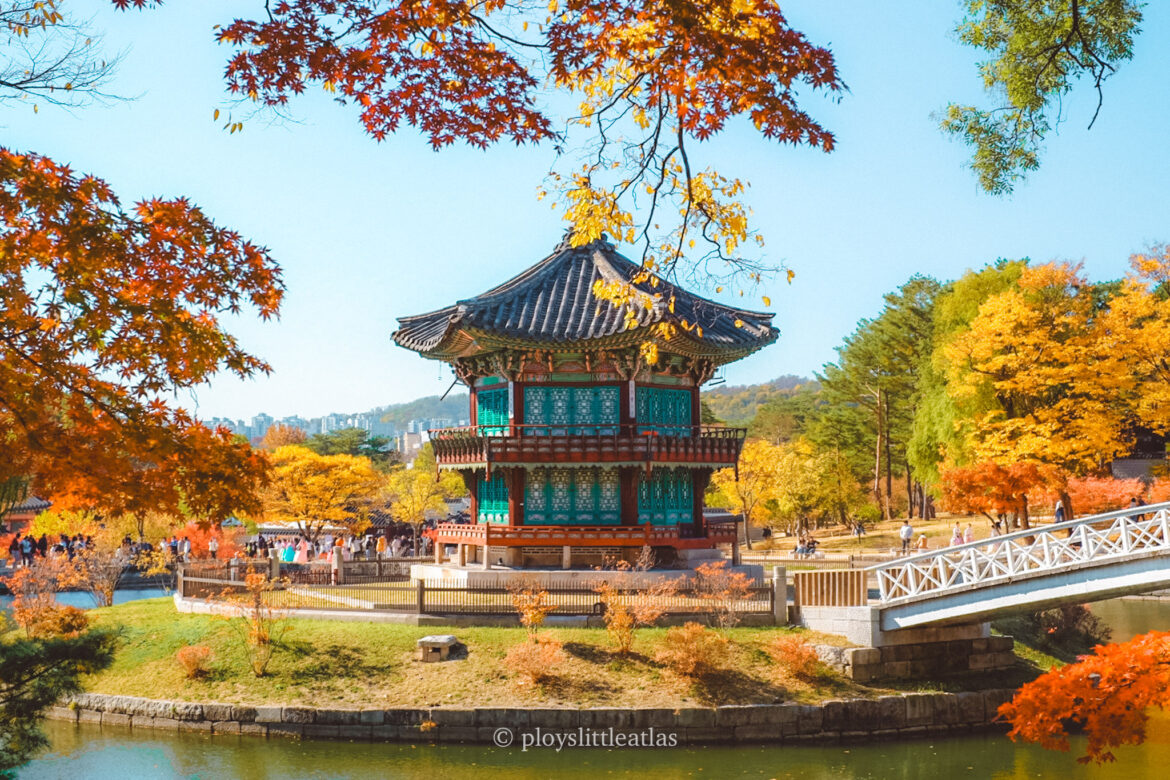
If there’s one place in Seoul that feels especially magical in autumn, it’s Gyeongbokgung Palace. Imagine traditional Korean architecture, elegant palace pavilions, peaceful ponds, and enormous golden ginkgo trees coming together to create some of the most beautiful autumn scenery in the city 🍂
While Gyeongbokgung is a must-visit destination throughout the year, I think autumn gives this historic palace an entirely different charm. The contrast between the vibrant golden foliage, traditional dancheong patterns, graceful tiled roofs, and serene palace grounds makes it a dream location for photography.
I’ve visited Gyeongbokgung in different seasons, but my recent autumn visit reminded me just how spectacular this place can be when the ginkgo trees turn golden.
In this guide, I’m taking you through my favorite photography spots inside Gyeongbokgung Palace, including where to find some of its most impressive ginkgo trees, the best viewpoints around the beautiful pavilions, and when to visit for the most vibrant autumn colors.
If you’re planning an autumn trip to Seoul, don’t forget to save this guide! 🤎
A Brief Introduction to Gyeongbokgung
Built in 1395 during the early Joseon Dynasty, Gyeongbokgung Palace (경복궁) is the largest of Seoul’s Five Grand Palaces and one of Korea’s most important historical landmarks.
Its name, Gyeongbokgung, can be translated as “Palace Greatly Blessed by Heaven.” The palace served as the principal royal residence and the political heart of the Joseon Dynasty.
Although much of the original palace complex was destroyed during the Japanese invasions and later periods of occupation, extensive restoration work has brought many of its historic buildings and courtyards back to life.
Today, Gyeongbokgung is one of the most popular attractions in Seoul, welcoming visitors who come to admire its traditional architecture, learn about Korean royal history, watch the changing of the royal guard, and, of course, take beautiful photographs.
But beyond the famous Gwanghwamun Gate and Geunjeongjeon Hall, the palace grounds hide several wonderful photography spots that become particularly enchanting in autumn.
Let’s explore them!
Where to Capture Autumn Photos within Gyeongbokgung Palace
One of the best things about photographing Gyeongbokgung in autumn is that you don’t have to wander too far to find beautiful scenery. There are several magnificent ginkgo trees scattered throughout the palace grounds, along with picturesque pavilions and traditional buildings that make wonderful photography backdrops.
Here are five spots I particularly recommend adding to your autumn photography route.
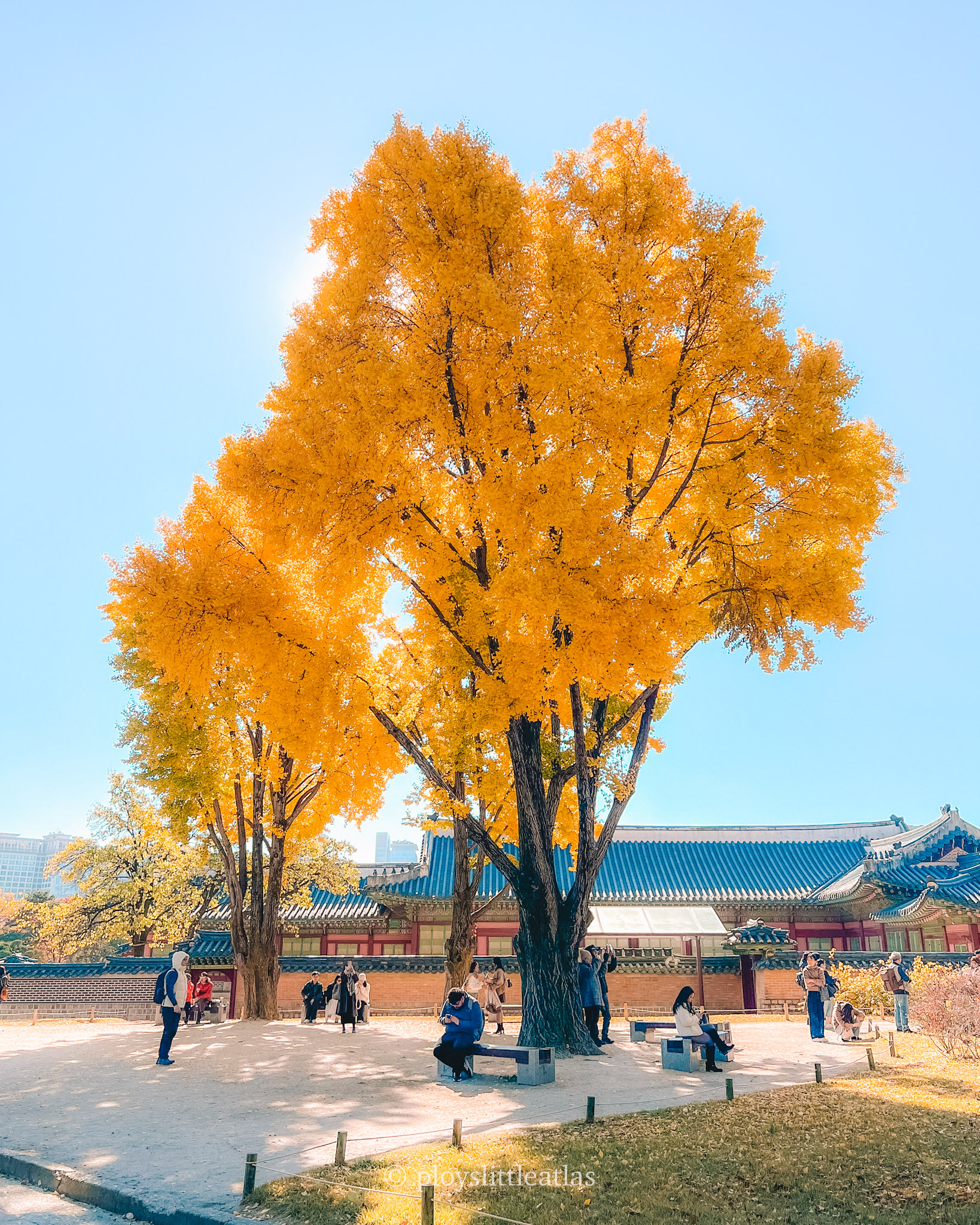
1. The Huge Ginkgo Tree by the National Palace Museum of Korea
Let’s start with one of the most impressive ginkgo trees around Gyeongbokgung!
Located near the National Palace Museum of Korea, this enormous ginkgo tree is a real showstopper when its leaves turn golden yellow.
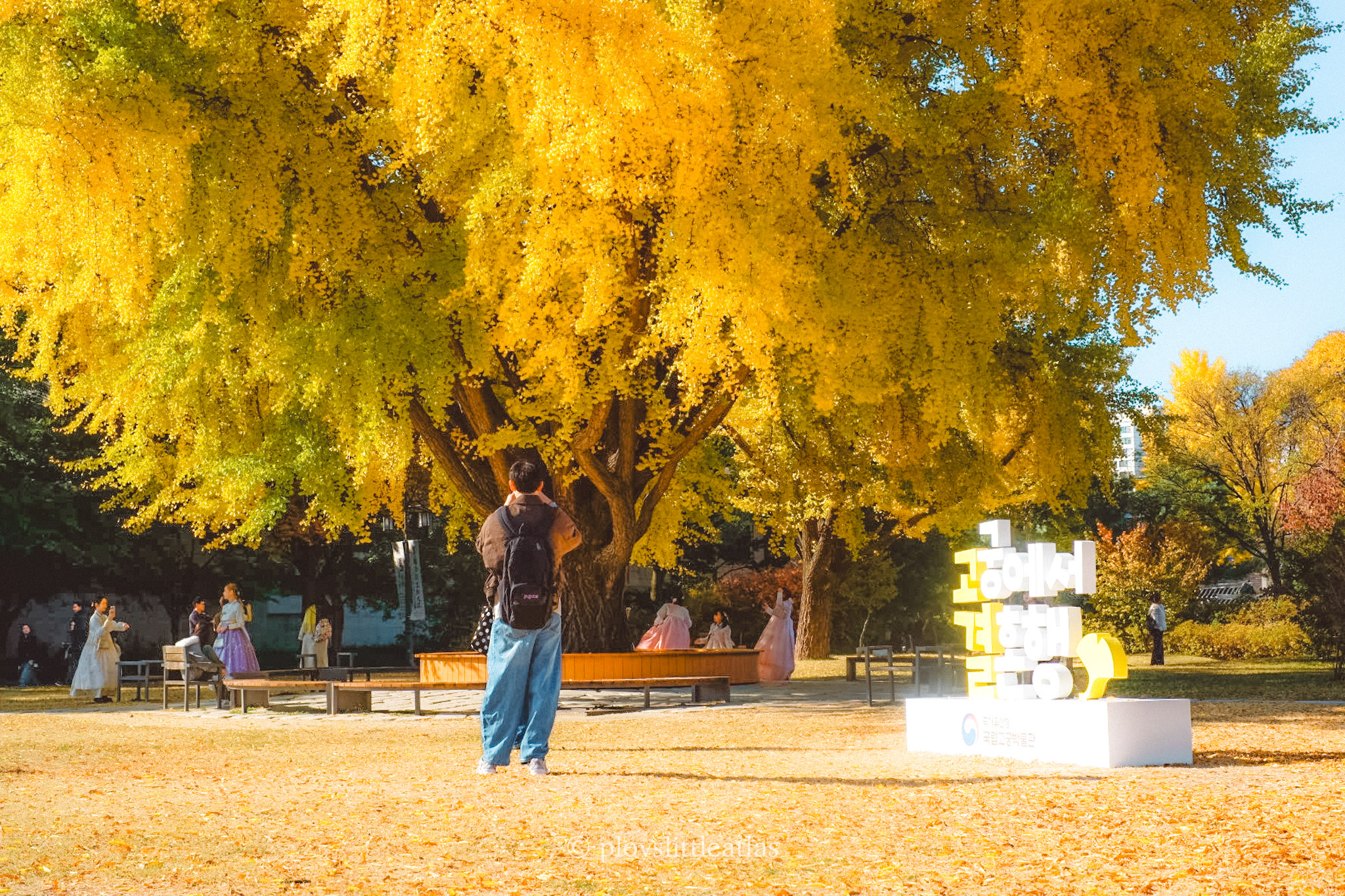
What makes this spot particularly beautiful is the contrast between the bright golden canopy and the traditional palace architecture surrounding it. The tree is so large that its branches create a beautiful natural frame, making it perfect for both portrait and landscape photography.
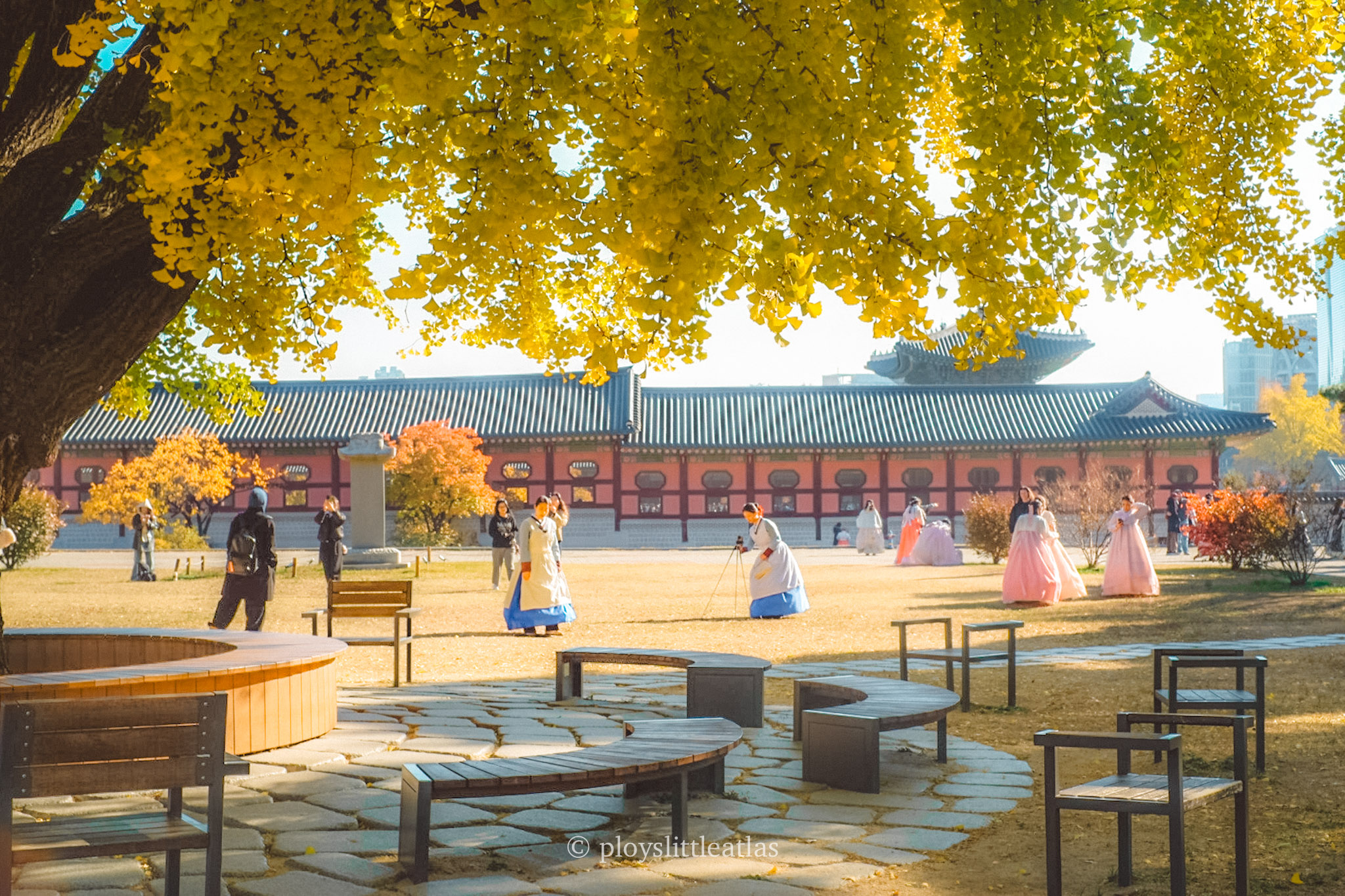
Photography tip: Try capturing the tree from a slightly lower angle to include as much of its golden canopy as possible. You can also use the surrounding traditional architecture as a framing element to give your photos a stronger sense of place.
2. Gyeonghoeru Pavilion (경회루) & Hayangjeong (하향정)
If you love photographing traditional Korean architecture, don’t miss the area around Gyeonghoeru Pavilion (경회루).
Gyeonghoeru is one of the most iconic structures within Gyeongbokgung. This beautiful two-storey pavilion stands beside a large rectangular pond and was historically used for royal banquets and important state occasions.
During autumn, the surrounding trees turn shades of yellow, orange, and red, creating a beautiful seasonal frame around the pavilion. On a calm day, the reflection of Gyeonghoeru on the water makes an especially lovely composition.
Just nearby, you’ll also find Hayangjeong (하향정), a smaller pavilion that offers another charming perspective of the palace grounds.
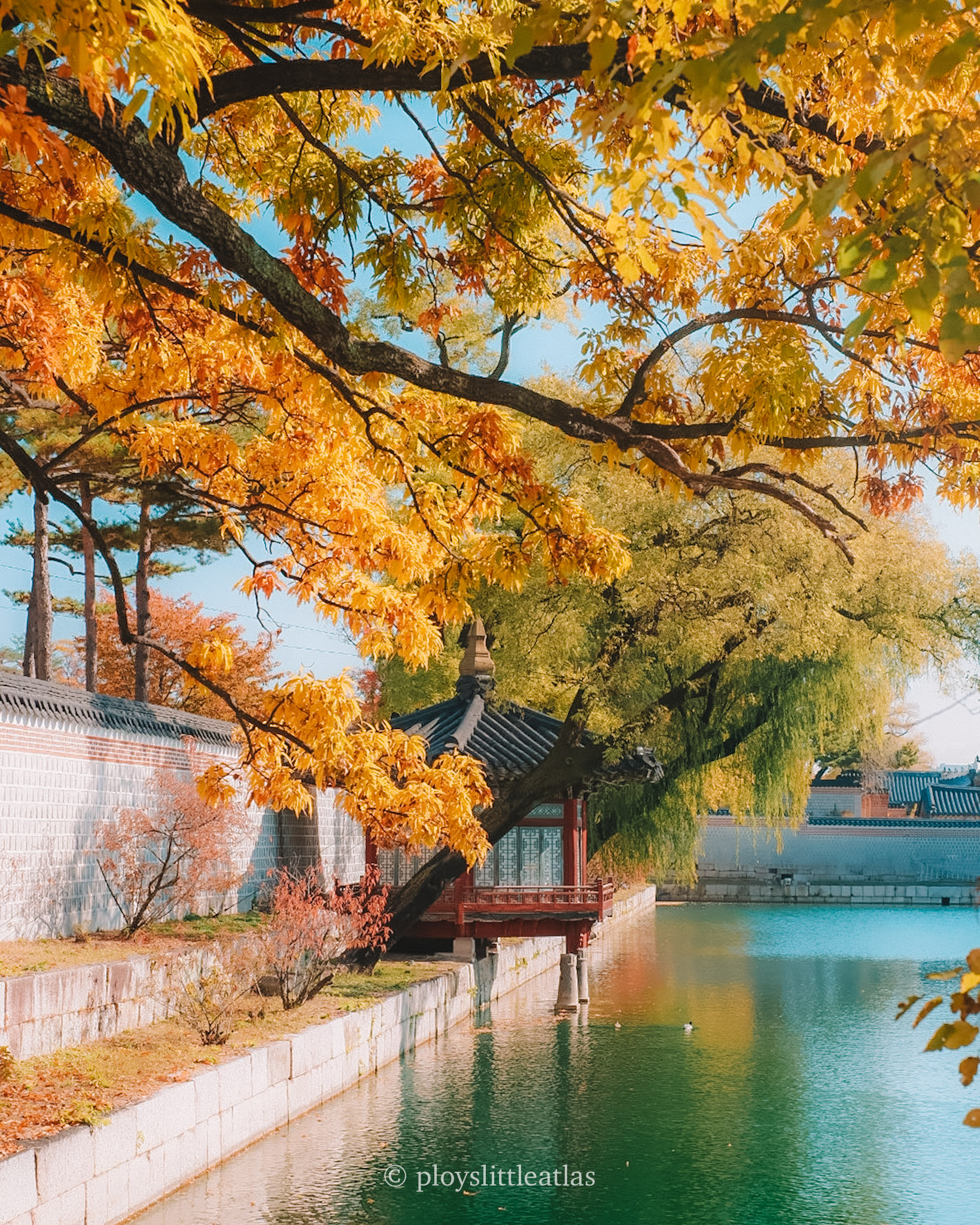
Photography tip: Don’t just photograph Gyeonghoeru from the usual straight-on viewpoint. Experiment with different angles along the pond, capturing the pavilion together with the autumn trees and their reflections. Including some foreground foliage can also add depth to your composition.
3. Hyangwonjeong (향원정)
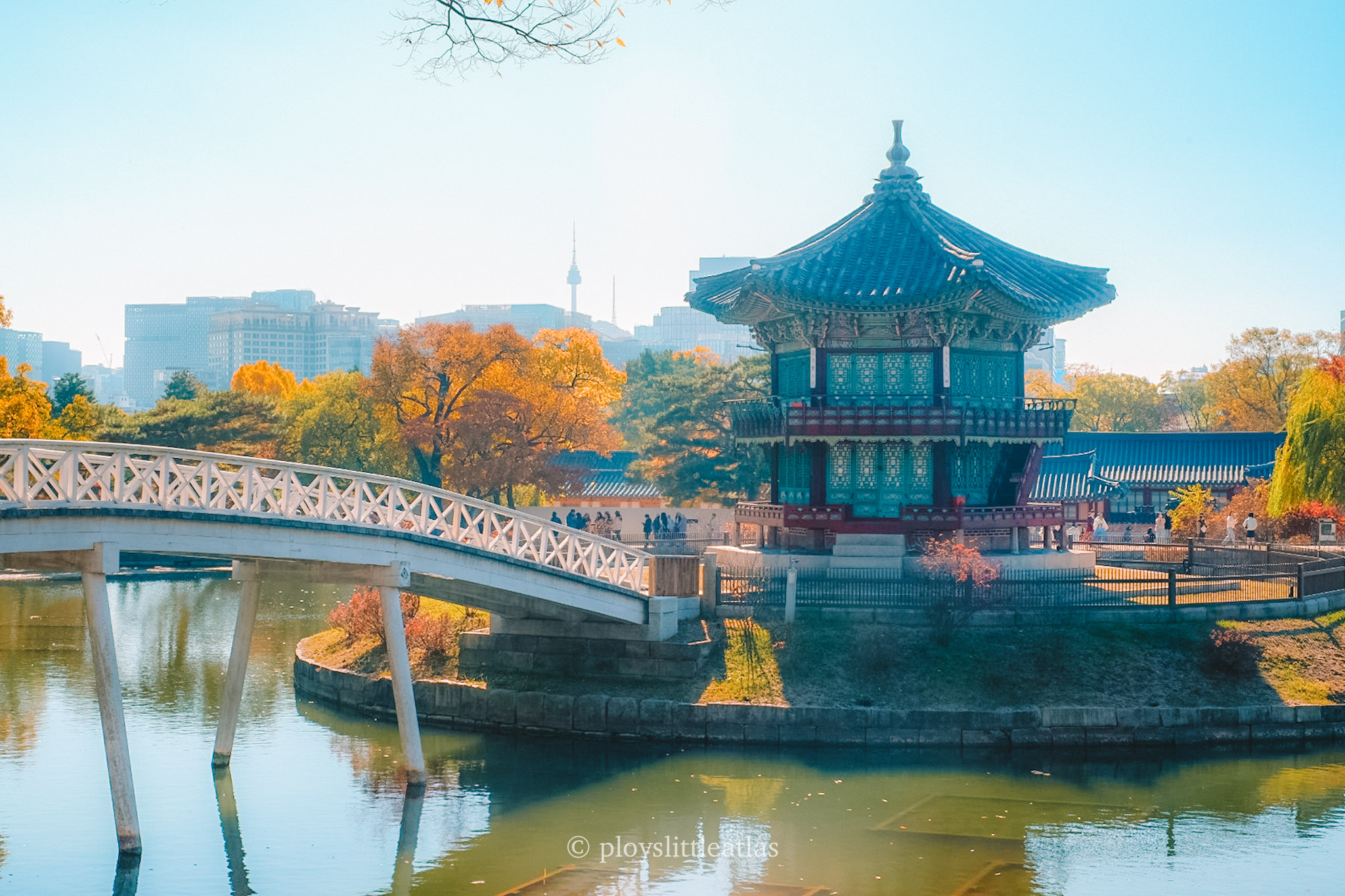
Perhaps one of the most romantic photography spots in Gyeongbokgung, Hyangwonjeong (향원정) is an absolute must during autumn.
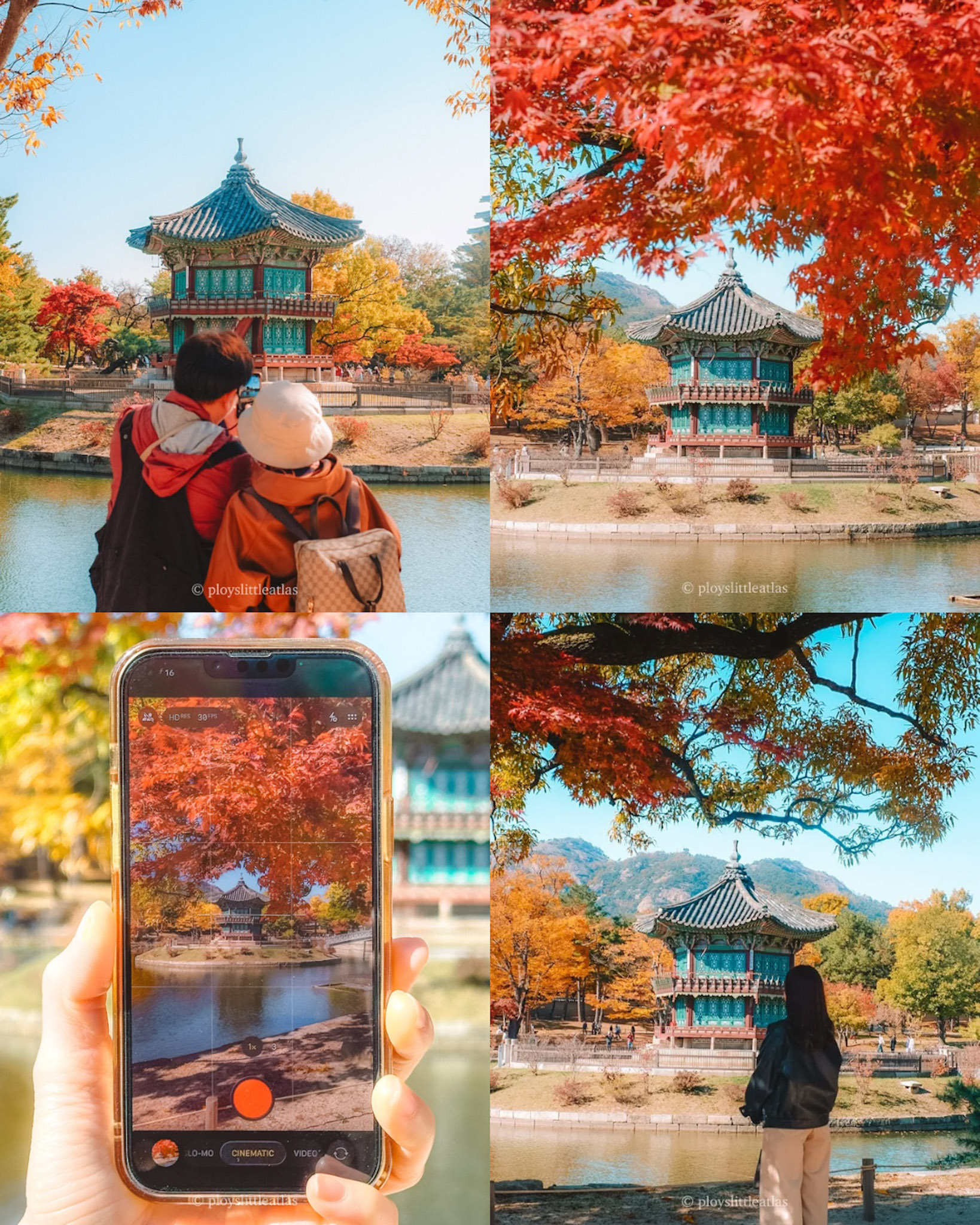
Located in the northern part of the palace, this elegant hexagonal pavilion sits on a small island in the middle of a tranquil pond. Its name means “Pavilion of Far-Reaching Fragrance,” and it was built during the reign of King Gojong.
The pavilion is connected to the northern shore by Chwihyanggyo Bridge, a beautiful wooden bridge that adds even more character to the scenery.
What makes this spot so special in autumn is the combination of the traditional pavilion, the surrounding trees, and the peaceful pond. When the foliage reaches its peak, the entire area becomes a beautiful mix of golden yellow, warm orange, and deep red.
Photography tip: Walk around the accessible paths surrounding the pond to find different compositions. Try photographing the pavilion through the autumn foliage or including the pond in your frame to capture its beautiful reflections. This is also a wonderful spot for wider landscape shots.
4. Another Huge Ginkgo Tree by Jagyeongjeon (자경전)
Here’s another magnificent ginkgo tree that deserves a place on your photography list!
Located near Jagyeongjeon (자경전), this part of the palace is particularly beautiful when the ginkgo leaves turn a brilliant golden yellow.
Jagyeongjeon was built as a residence for Queen Sinjeong, the mother of King Heonjong. The building is also known for its beautiful traditional architectural details and its historic chimneys.
I especially love how the golden foliage complements the palace’s traditional rooflines and colorful dancheong decorations. The combination creates that quintessential Korean autumn atmosphere that is hard to resist photographing.
Photography tip: Look for compositions that capture the golden ginkgo canopy together with the palace roof. If you’re taking portraits, position your subject beneath the tree to make the most of the beautiful golden background.
5. Another Huge Ginkgo Tree by Geonchunmun Gate (건춘문)
Last but certainly not least, make your way towards Geonchunmun Gate (건춘문), the eastern gate of Gyeongbokgung.
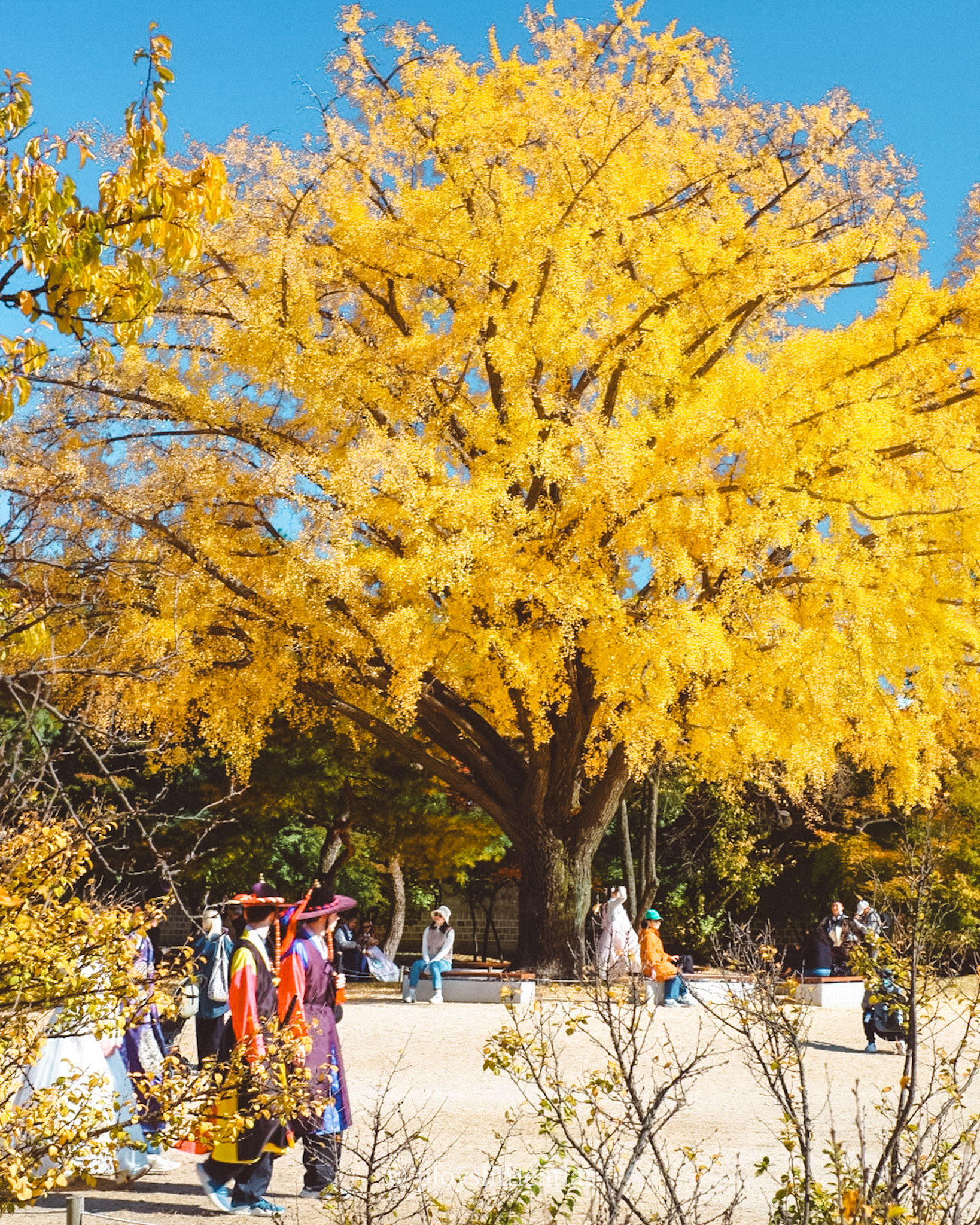
There’s another impressive ginkgo tree nearby, and when it reaches peak color, it creates a beautiful golden scene against the historic palace surroundings.
I love that Gyeongbokgung has several magnificent ginkgo trees in different corners of the palace. Rather than concentrating all your photography around one famous landmark, you can explore the grounds and discover these beautiful seasonal moments along the way.
This is another great place to capture the contrast between the golden foliage and traditional Korean architecture.
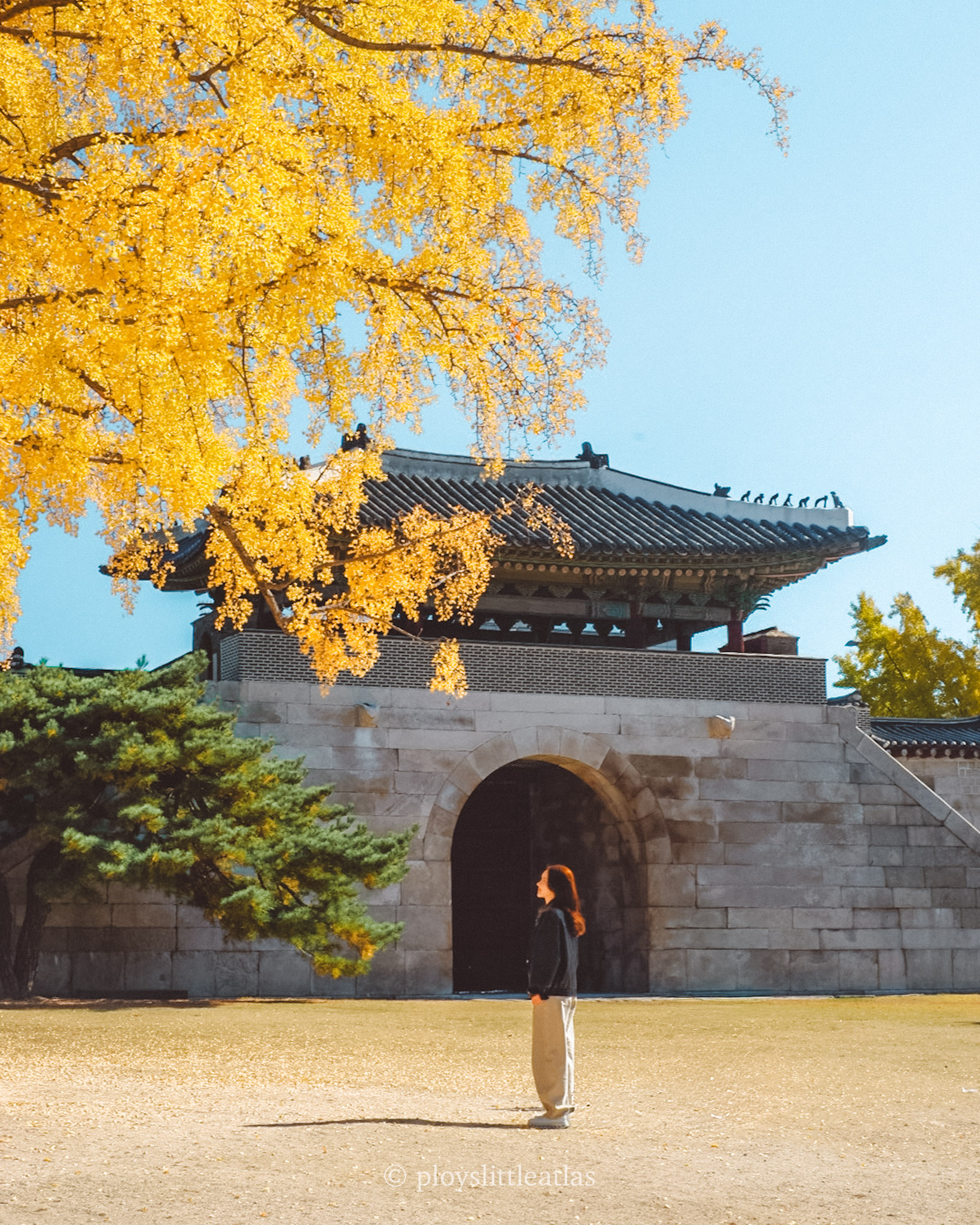
Photography tip: Experiment with wider shots that show the relationship between the tree and the gate, as well as close-up shots of the leaves. Don’t forget to look upwards!
When to Catch Autumn Peak at Gyeongbokgung Palace
If you’re planning your visit specifically for autumn photography, I would recommend keeping an eye on the first and second weeks of November.
The series of photographs featured in this post were captured on November 6th, and I couldn’t have asked for a better time to visit!
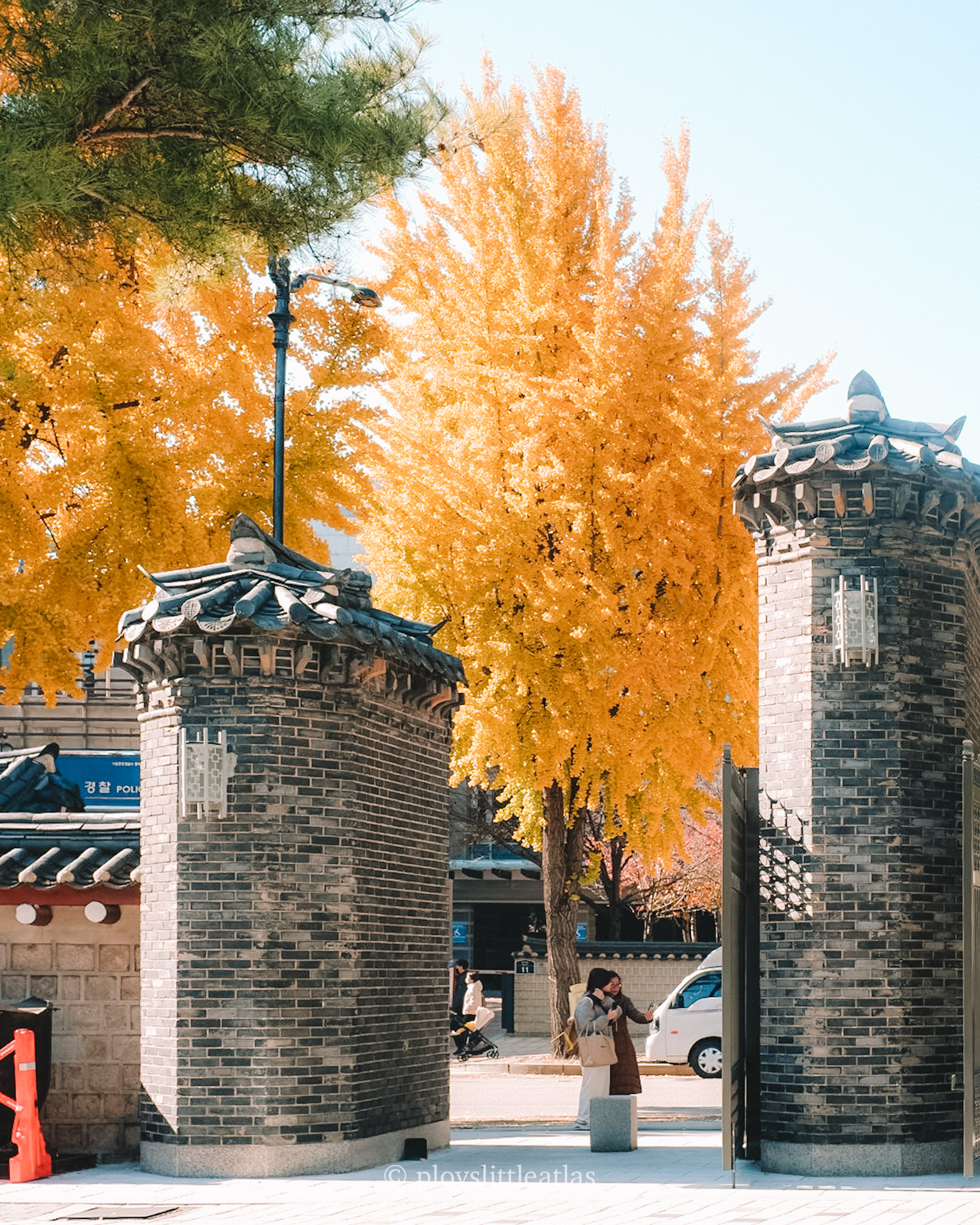
The ginkgo trees throughout the palace grounds were at their sweet spot of autumn vibrancy, displaying beautiful shades of golden yellow. The deciduous trees were also showing lovely autumn colors, creating a wonderful combination of seasonal foliage throughout the palace.
Of course, autumn foliage timing varies slightly from year to year depending on temperatures and weather conditions. Some trees may turn earlier, while others take a little longer to reach their peak.
My recommendation is to aim for early to mid-November if you want to catch Gyeongbokgung at its most colorful. If golden ginkgo trees are your main priority, the first half of November is particularly worth watching.
And if you’re visiting Seoul around this time, don’t wait too long! Ginkgo leaves can fall quite quickly, especially after strong winds or rain.
Pro Tips for Autumn Photography at Gyeongbokgung
A little planning can make a big difference when photographing Gyeongbokgung, especially during the busy autumn season. Here are a few tips to help you make the most of your visit.
1. Arrive early in the morning.
Gyeongbokgung is one of Seoul’s most popular tourist attractions, so crowds are almost inevitable. I recommend arriving around opening time, particularly if you want clean shots of the palace architecture and beautiful trees without too many people in the background.
2. Visit on a weekday if possible.
Weekends can get particularly busy during peak autumn foliage season. If your schedule allows, choose a weekday for a more relaxed photography experience.
3. Check the foliage conditions before visiting.
Don’t rely entirely on the calendar! Autumn foliage changes every year depending on the weather. Keep an eye on recent visitor photos and Seoul autumn foliage updates to make sure you don’t miss the golden ginkgo trees at their best.
4. Bring a wide-angle lens.
Some of the ginkgo trees inside Gyeongbokgung are absolutely enormous. A wide-angle lens is particularly useful for capturing their full canopy alongside the surrounding palace architecture.
5. Experiment with different compositions.
Don’t limit yourself to straightforward landscape photographs. Try shooting upwards through the golden leaves, framing palace buildings between tree branches, capturing reflections in the ponds, or taking portraits with autumn foliage in the background.
6. Wear something that complements the autumn scenery.
If you’re planning to take portraits, neutral, cream, brown, beige, and burgundy outfits work beautifully against the golden foliage and traditional Korean architecture. Of course, wearing a beautiful hanbok is another wonderful way to make your photographs extra special!
7. Allow enough time to explore.
Gyeongbokgung is much larger than it might initially appear. Don’t rush between the famous landmarks. Some of the most beautiful photography opportunities are found while wandering between different palace buildings and courtyards.
8. Check the admission fee before your visit.
The standard admission fee for Gyeongbokgung Palace is ₩3,000 per adult (ages 19–64 for international visitors). Admission is free for visitors aged 18 and under, those aged 65 and above, and visitors wearing a qualifying complete hanbok.
One little bonus: if you’re visiting on the last Wednesday of the month (Culture Day), you can also enjoy free admission!
Special note for November 2026: As part of the Korea Grand Festival, Gyeongbokgung is offering free general admission from October 29 to November 15, 2026, excluding its regular closing day. So if you’re planning to visit around the peak autumn foliage period this year, it’s a great opportunity!
9. Remember that Gyeongbokgung is closed every Tuesday.
This is particularly important when planning your Seoul autumn itinerary! Gyeongbokgung Palace is regularly closed every Tuesday.
If a Tuesday falls on a public holiday or substitute holiday, the palace opens that day and closes on the next non-holiday instead.
Also, keep in mind the seasonal operating hours:
- November–February: 09:00–17:00 (last admission 16:00)
- March–May & September–October: 09:00–18:00 (last admission 17:00)
- June–August: 09:00–18:30 (last admission 17:30)
I recommend arriving early, especially if you want to photograph the palace without too many visitors in your shots.
Final Thoughts: Is Gyeongbokgung Worth Visiting in Autumn?
Absolutely! While Gyeongbokgung is already one of Seoul’s most beautiful historical attractions, autumn takes its charm to another level.
What I particularly love is the variety of scenery you can capture within one palace complex. From enormous golden ginkgo trees and colorful deciduous foliage to elegant traditional pavilions reflected in peaceful ponds, there’s something beautiful waiting around almost every corner.
If you’re visiting Seoul in November and looking for somewhere to enjoy the autumn colors while experiencing a little Korean history and culture, Gyeongbokgung should definitely be on your itinerary.
And remember, don’t just stop at the main palace hall! Take your time exploring the grounds, follow the golden foliage, and discover all the beautiful corners that make Gyeongbokgung such a wonderful autumn photography destination.
Happy autumn exploring! 🍂🤎
Access Map:
Did this entry help you? Or Did you enjoy my photos? Help support my small blog by giving a little cup of joe. I am always grateful when readers reach out wanting to support 🙂
p.s. This post is independently created. However, when you book or purchase something through the retail links, I may earn an affiliate commission to help keep Ploy’s Little Atlas running. Thank you very much for your support!
p.p.s All images used (unless specified) are owned by the author of the blog and permission is required for a repost. Please, reach out via social media channels to ask beforehand if you’d like to use them.